
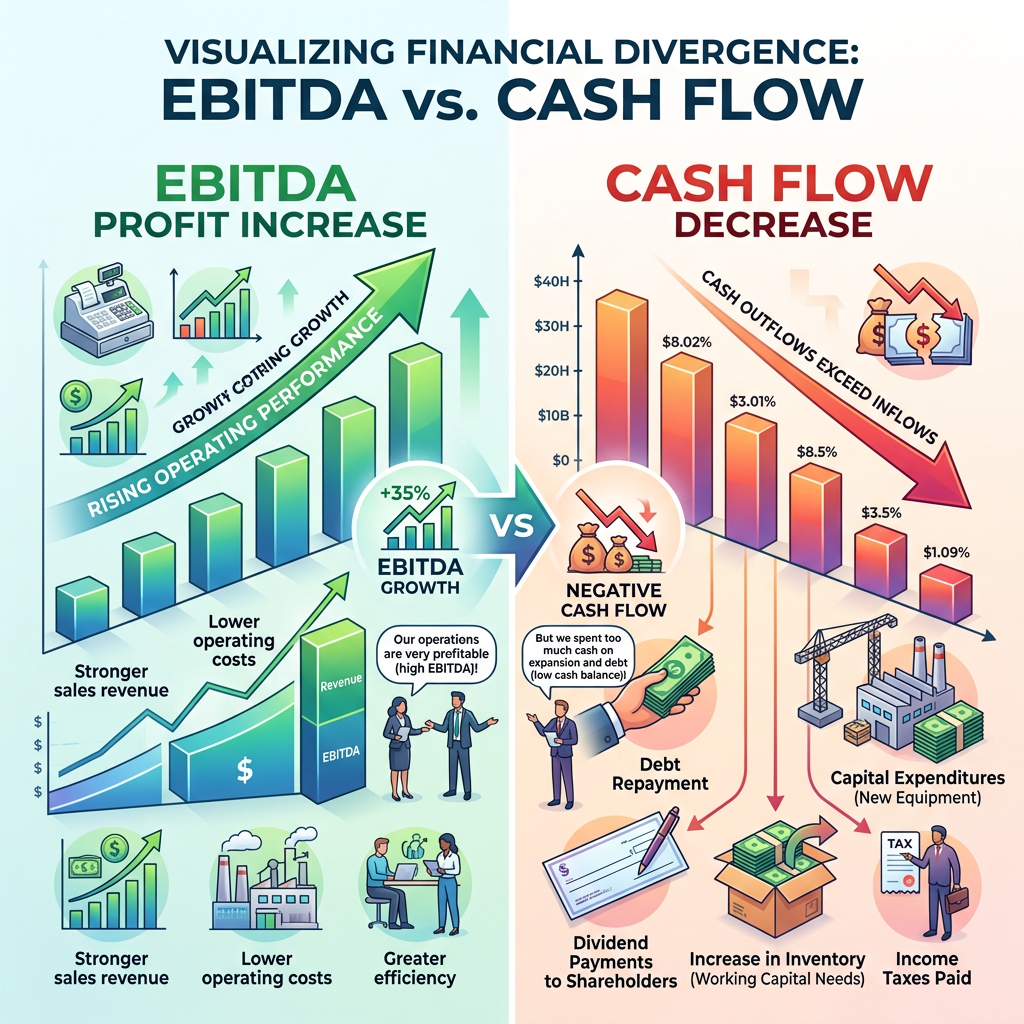
It’s one of the most commonly misunderstood numbers in business.
A business owner tells me:
“We’re making $5 million EBITDA, so why does it always feel like we’re short of cash?”
Because EBITDA is not the same as cash generated by the business.
EBITDA is useful. It helps us understand the underlying operating performance of a business before interest, tax, depreciation and amortisation.
But it doesn’t tell us how much cash is actually available.
Consider a simplified example:
$5.0m EBITDA
Less:
→ Tax
→ Interest
→ Increase in working capital
→ Capital expenditure
→ Other cash commitments
What remains is the cash the business can actually deploy.
And this distinction becomes even more important when a business is growing.
Imagine revenue increases by 20%.
That may require:
More inventory
More receivables
More people
More equipment
More premises
The P&L may look stronger.
But the cash position can deteriorate.
This is why I like to look at three questions together:
1. PROFIT
Is the underlying business economically profitable?
2. CASH
Is that profit converting into cash?
3. CAPITAL
How much capital is required to generate and sustain that profit?
Because ultimately, a business doesn’t fund its growth with EBITDA.
It funds growth with cash and capital.
And when assessing a major business decision, I would always ask:
“How much additional cash will this decision consume before it starts generating cash?”
That question can change the entire way you think about growth.
A strong EBITDA number is encouraging.
But cash generation, capital efficiency and the return on that capital are what ultimately determine whether growth is creating value.
#BusinessGrowth #CashFlow #EBITDA #CapitalAllocation #ValueCreation #CorporateAdvisory


Leave a Reply